
Module 10: Hands-On Training & Skill Validation
Practical IV Insertion Training
Hands-on training is essential for mastering IV therapy skills. This module focuses on practical IV insertion, drip rate calculations, emergency response scenarios, and competency assessment to ensure proficiency and patient safety.
🔹 Objectives of Hands-On IV Training:
Develop technical skills in IV insertion and fluid management.
Gain confidence in handling complications and emergency scenarios.
Ensure compliance with best practices and safety protocols.
Validate skills through competency assessments and certification.
A. Training on IV Cannulation Techniques
🔹 Live Practice Models & Simulation Equipment:
Perform Hand Hygiene & Wear PPE.
Select Appropriate Vein & Gauge Size.
Apply Tourniquet (4-6 inches above the selected site).
Disinfect IV Site with Chlorhexidine (30-sec scrub, air dry).
Insert the IV Catheter at a 15-30° Angle, Bevel-Up.
Observe for Flashback, Advance the Catheter, and Remove the Needle.
Secure IV with Tegaderm and Connect IV Tubing.
Flush IV with Normal Saline (Check for Patency).
Label the IV Site & Document Insertion Details.
🚨 Live Training Tips:
ands-on practice with preceptors or trainers for real-time feedback.
Simulate difficult vein scenarios (e.g., dehydrated patients, collapsed veins).
Train with ultrasound-guided IV insertion for complex cases.
Drip Rate Calculation Training
A. IV Flow Rate Calculation (Gravity Drip Method)
For manual IV drips, calculate flow rate using:

🔢 Example Calculation:
Order: 1000 mL Normal Saline over 8 hours
Drip Factor: 15 gtt/mL
Calculation:

✅ Adjust roller clamp to approximately 31 drops per minute.
B. Infusion Pump Rate Calculation
For IV infusion pumps, use:

🔢 Example Calculation:
Order: 1000 mL over 8 hours
Pump Setting:

✅ Set infusion pump to 125 mL/hr.
🚨 Practice Exercise:
1️⃣ Calculate drip rate for 500 mL over 4 hours using 10 gtt/mL tubing.
2️⃣ Set up IV pump for 750 mL infusion over 6 hours.
Simulated Emergency Scenarios for Complication Management
Emergency drills train healthcare providers to recognize and manage IV-related complications quickly.
A. Common Simulated Scenarios:
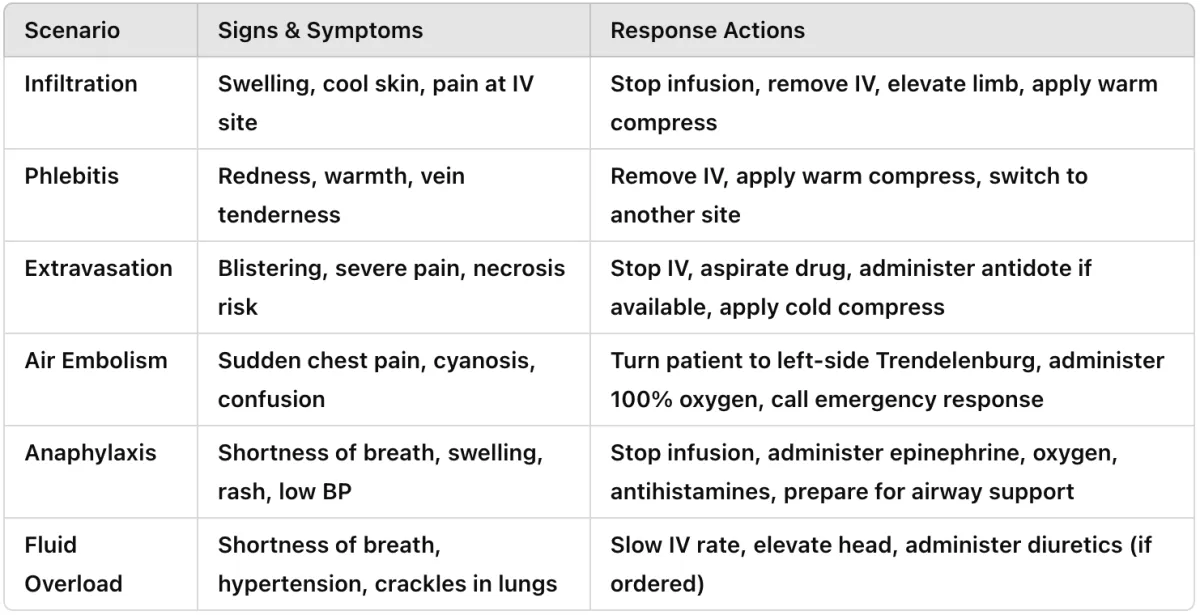
🚨 Live Training Simulation:
Role-play a nurse responding to an IV complication in a real-time scenario.
Train with emergency medication kits (e.g., epinephrine for anaphylaxis).
Use high-fidelity manikins to mimic real patient responses.
Competency Assessment & Certification
A. IV Therapy Skills Validation Checklist
Pre-Assessment Written Test – Covers theory, calculations, and safety protocols.
Hands-On IV Insertion Evaluation – Direct observation by a trainer.
Infusion Pump & Gravity Drip Calculation Test – Setting up IVs accurately.
Emergency Response Drill Participation – Simulated complication management.
✅ Successful trainees receive an IV Therapy Certification, verifying competency in IV insertion, medication infusion, and emergency response.
B. Ongoing IV Competency Assessment
Annual IV skills re-evaluation for continued certification.
Live feedback from supervisors for improving techniques.
Record-keeping of IV success rates and complications handled.
Hands-on IV training bridges the gap between theory and clinical practice, ensuring safe and efficient IV therapy administration. Competency assessment and certification validate a healthcare provider’s ability to insert IVs, calculate infusion rates, and handle emergencies effectively.
Mark This Lesson as Complete
And we will be sending you the next lesson so you can keep learning!
Copyright © 2026 Medical Entrepreneur, All rights reserved.