They priced you out of a skill your license already lets you use.
IV therapy isn't hard to learn. It was made expensive to learn — by seminar companies charging $5,000 a weekend for what a practicing physician can teach you online for the price of a single infusion.
So one did. 12 modules. 90+ lessons. Cannulation to compliance to your first paying client.
One-time payment · Lifetime access · 30-day money-back guarantee. This is a certificate of completion, not a state license.
Why this exists
Dr. Adam Sewell kept meeting the same clinician.
A nurse practitioner. A registered nurse. A PA opening a practice. Fully licensed, clinically sharp, already starting IVs in a hospital or a clinic every week. And every one of them believed the same thing: that to add a cash-pay IV service, they first had to pay thousands of dollars and give up a weekend to a seminar company in a hotel ballroom.
He'd sat in those rooms. He knew what was in them — a day and a half of didactic slides, a laminated handout, and a certificate that impressed no medical board because a certificate isn't a license anywhere. The clinical content? He could teach it in an afternoon. The part that actually stops people — the compounding math, the standing orders, the medical-director question, the how do I get my first patient in the chair — most of those seminars skipped entirely.
So he built the course he wished those clinicians had been handed. Every protocol, every consent template, every compliance checklist is drawn from the same materials used in operating practices across Texas, Arizona, and California — where he has actually integrated IV therapy into real clinics, not just lectured about it.
He put the whole thing online, self-paced, for $197 — less than the margin on a single IV visit. Not because the knowledge is worth less. Because gatekeeping it was never the point.
What this is — and what it stands against
The seminar was built for the seminar company. This was built for you.

The $5,000 weekend seminar
- Fixed date, a flight, a hotel, a lost weekend
- A day and a half of slides, then you're on your own
- Compounding math? Usually skipped
- "How do I get my first patient?" — not their problem
- Priced to gatekeep, not to teach
This certificate program
- 100% online, self-paced, lifetime access
- 12 modules, 90+ lessons — didactic depth seminars can't fit in a weekend
- An entire module on dose-to-volume, osmolarity, and infusion-rate math
- A 30-day roadmap to your first cash-pay client
- $197 — less than one IV visit's margin

Built by a physician who actually runs the service he's teaching.
This certification wasn't written by a marketer or a course factory. It was built by a practicing, triple board-certified physician who has integrated IV therapy into real clinics — and who signs off personally on every clinical claim in the program.
- Triple board-certified, MD — decades of clinical practice
- Has built and run cash-pay IV services in Texas, Arizona & California
- Personally reviews and signs off on every clinical claim in the course
- Author and educator — teaches the compounding math most courses skip
Not ready to enroll? Start here, free.
The free guide to the four pillars of an IV therapy practice.
Get the free Four Pillars guide from Adam Sewell, MD: the medical director, standing orders, the good faith exam, and charting. It covers what each one is, what it has to contain, and where IV therapy plans usually break. It also comes with the Chair-Hour Calculator, so you can run the numbers with your own pricing and costs.
Free. One email with your access link. Unsubscribe anytime. Education, not legal advice. Every state-specific answer points you to your own board and counsel.

The curriculum
Twelve modules, 90+ lessons — fundamentals to running the service inside the practice you already have.

Introduction to IV Therapy
Clinical indications and where a cash-pay service fits.
Anatomy & Physiology for IV Therapy
Vascular anatomy and fluid dynamics.
IV Equipment & Supplies
Catheters, tubing, solutions, and equipment standards.
Preparing for IV Administration
Sterile technique and pre-infusion safety checks.
IV Drip Formulations & Uses
Indications, components, and contraindications.Every formulation requires an authorized prescriber's order.
IV Cannulation & Administration Techniques
Vein selection and cannulation technique.
Infusion Safety & Complications
Infiltration, extravasation, and adverse-event management.
Sharps Training & Waste Disposal
OSHA, DOT, and EPA compliant handling.
Documentation & Billing
Clinical documentation standards and cash-pay coding fundamentals.
Hands-On Training & Skill Validation
A structured competency framework.Completion certifies coursework, not independent licensure.
Implementing IV Therapy in Medical Practice
Workflow integration using existing rooms and staff.
IV Formulation & Compounding Calculations
Dose-to-volume, final concentration, osmolarity checks, pump & gravity rates.Calculation method only, verified against the order and package insert.
This program provides didactic instruction. Hands-on venipuncture competency must be validated in person by a qualified validator — Module 10 covers who can serve as a validator and what the sign-off record must contain.
The part most IV courses skip
The real reason clinicians hesitate: the math.
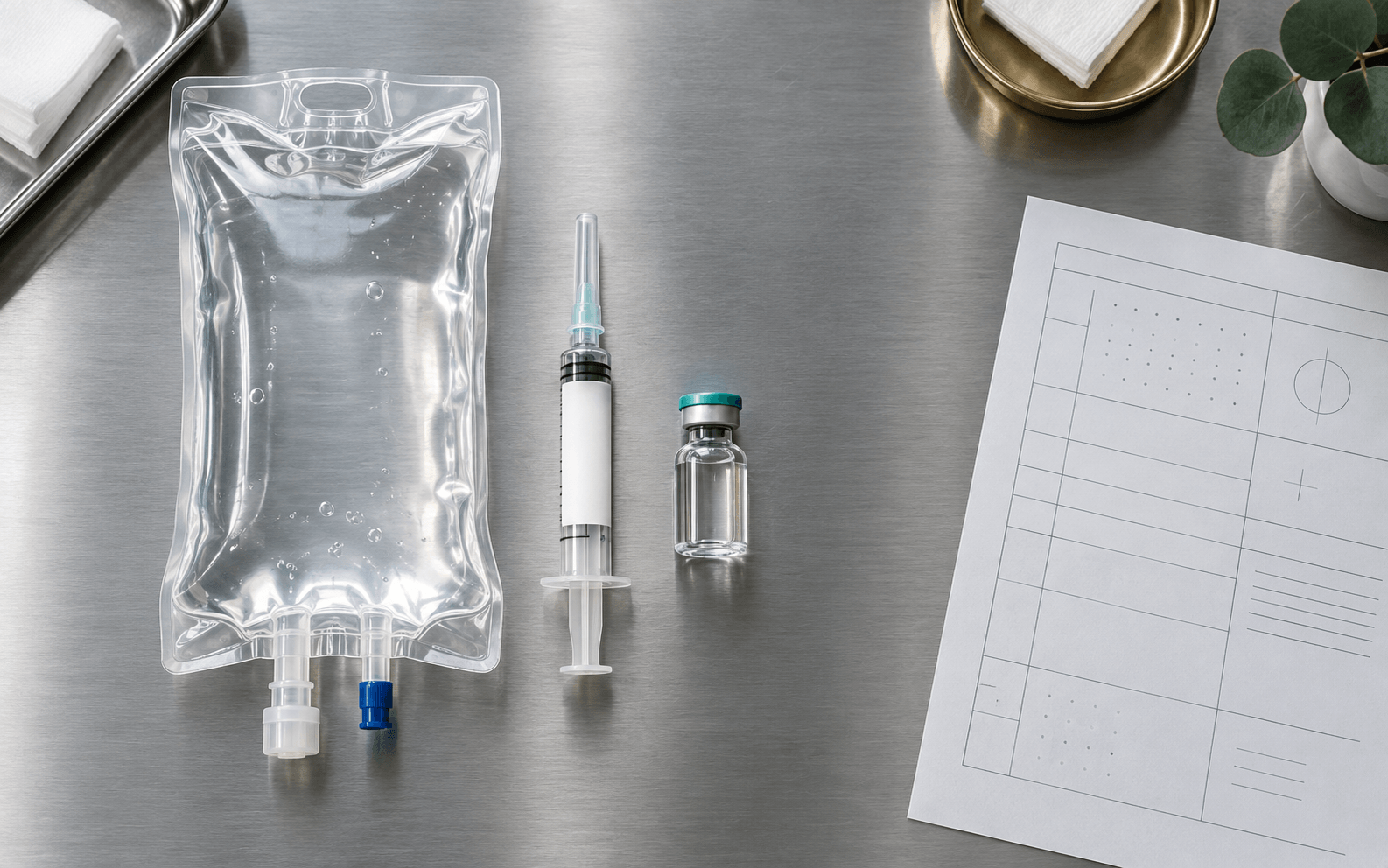
Dosing and dilution errors are among the most common — and most dangerous — mistakes in IV therapy. It's also the quiet fear that stops capable clinicians from starting. Module 12 removes the guesswork with one repeatable compounding sequence you run every time:
- Convert any ordered dose into an exact draw volume
- Calculate final concentration and total bag volume
- Check osmolarity — know when a drip needs central access
- Set a safe rate in mL/hr (pump) and gtt/min (gravity)
Worked examples, a quick-reference formula table, and a knowledge check. Teaches calculation method; every dose and limit still comes from a valid order and the manufacturer's package insert.
What clinicians say · 4.9 / 5 average
Physicians, NPs, and PAs across the country.
"Very comprehensive overview of IV therapy. Direct and specific, with videos mixed in to re-cap the written content."
"Exactly what I needed to feel confident adding this to my clinic."
"The done-for-you protocols and consent forms saved me weeks of work."
"As a PA opening my own practice, the compliance and delegation modules were worth the price alone."
Reviews shown are drafts pending verification and are not yet live claims.
The investment
Three ways to look at $197.

Against one IV visit
A single cash-pay infusion commonly runs $100–$400. The entire course costs less than the margin on one visit. Every visit after that is yours.
Against the seminar
The in-person route runs $5,000+ before travel, plus a lost weekend — for less curriculum than this. Same clinical education, roughly 90% less cost.
Against the empty chair
An exam room sitting idle earns nothing. The cost that should worry you isn't $197 — it's another quarter of not offering a service your patients are already buying elsewhere.
What's included
12 modules, 90+ lessons, the clinical glossary & reference library, the cash-pay pricing strategy guide, certificate of completion, and lifetime access — including modules added after you enroll.
The 30-day money-back guarantee
Put the program to work. If it isn't the right fit within 30 days, email us and we'll issue a prompt, 100% refund — no forms, no hoops, no questions asked. Your satisfaction is guaranteed.
Optional after enrollment: a done-for-you template library — standing-order, consent, HIPAA and intake templates, and clinical SOPs. Templates are starting points, not legal advice; your medical director and a health-law attorney should review all forms and standing orders before clinical or commercial use.
Straight answers
The questions clinicians actually ask.
Can a nurse practitioner or RN open an IV hydration service independently?
Is this certificate a license to practice IV therapy?
What legal documents does a compliant service need?
Does the course teach dosing and compounding calculations?
How long does it take to launch?
How much does it cost to add IV therapy to an existing practice?
Your move
The skill was never the barrier. The price tag was.
Get certified, get compliant, and get patients in the door — without the flight, the ballroom, or the $5,000. Start today for $197.
Enroll now — $197Or take the free launch guide first — start here.
This course is for educational purposes and provides a certificate of completion, not a state license or independent authorization to practice. Practitioners are responsible for compliance with their own state medical or nursing board. Content is education, not legal advice; state-specific requirements must be confirmed with your board and counsel. No specific earnings or income outcomes are promised or implied.