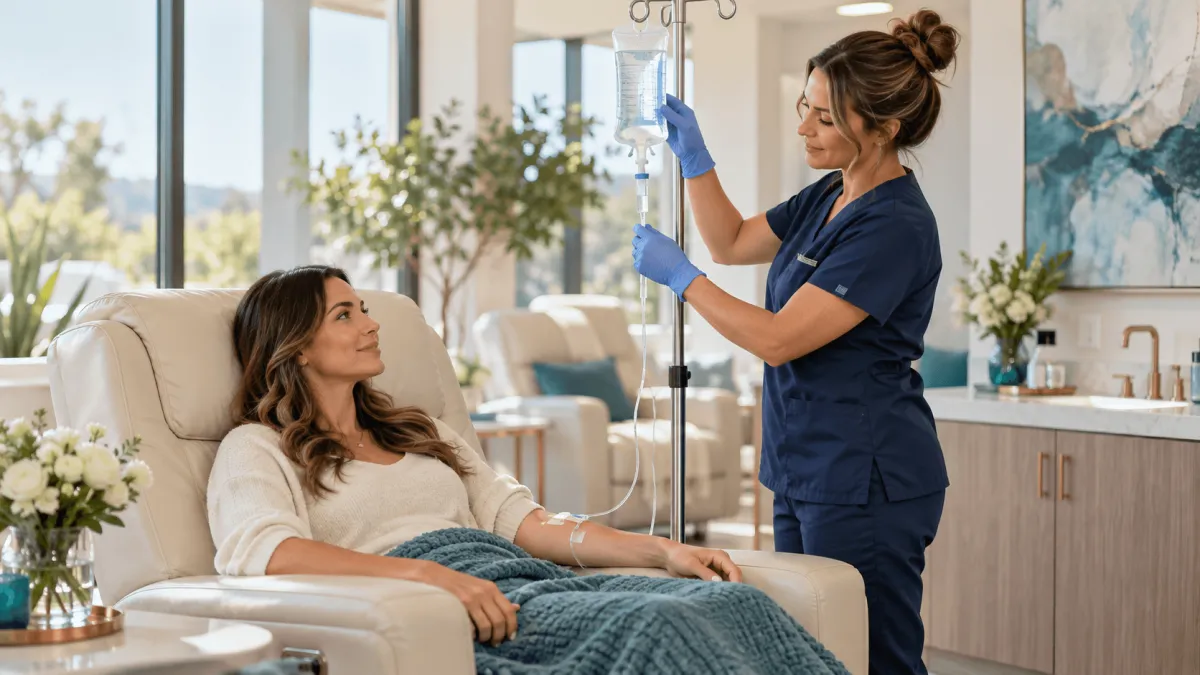
What Clinicians and Nurses Need to Know Before Launching an IV Therapy Service
IV therapy is no longer a niche wellness add-on. In 2026 it is one of the fastest-growing cash-pay services in aesthetic and regenerative medicine, and patients are actively searching for it. If you are a physician, nurse practitioner, PA or registered nurse thinking about starting an IV therapy business, the opportunity is real. So are the new rules.
This guide breaks down the IV therapy trends 2026 data that matter to clinicians: what patients type into Google, which drips are growing, what the market is worth, and how laws like Texas's Jenifer's Law change who can run an IV therapy service.
Quick answer: What are the biggest IV therapy trends in 2026?
The biggest IV therapy trends in 2026 are (1) local, ready-to-book searches such as "IV therapy near me," (2) rapid interest in NAD+ IV therapy for energy and longevity, (3) growth in mobile IV therapy and memberships, (4) IV support for patients on GLP-1 weight-loss medications, and (5) tighter safety rules, including Texas's Jenifer's Law, which sets a registered nurse minimum for elective IV therapy outside physician offices. The U.S. IV hydration therapy market is estimated at about $1.1 billion in 2025 and is projected to grow roughly 8 to 9% per year.
What Patients Are Searching For: The Top 10 IV Therapy Keywords in 2026
Patient search behavior tells you where demand is. Most IV therapy searches are local and transactional: the patient wants a drip today, close by. That is good news for a clinic that already has a physical location and a Google Business Profile.
Rank | What patients search | What it tells a clinician |
|---|---|---|
1 | IV therapy near me | Local demand is the biggest driver; your map listing matters most. |
2 | IV therapy [city] | Patients compare clinics by town; build a page for each area you serve. |
3 | NAD+ IV therapy | The hottest named drip; one aggregator lists about 22,200 monthly searches with low competition. |
4 | IV drip near me | Same-day booking intent; online scheduling converts. |
5 | Mobile IV therapy / IV therapy at home | The fastest-growing delivery channel. |
6 | IV hydration therapy | Peaks in summer heat and race season. |
7 | Myers' cocktail | A mature, trusted entry-level drip. |
8 | NAD+ injections | Patients are shifting from long infusions to shorter shots. |
9 | Hangover IV | Highly seasonal: holidays, New Year's, big events. |
10 | Glutathione IV | Beauty-driven demand, strong on social media, with real regulatory caution. |
These rankings are directional estimates built from published agency data and trend reports, not a single SEO tool export. Before you set an ad budget, check local volumes for your city in Google Keyword Planner.

Why this matters for your IV therapy business: a clinician who ranks in the local map pack for "IV therapy near me" will usually out-earn a competitor with a better menu but weaker local visibility.
6 IV Therapy Treatments Trending in 2026
1. NAD+ IV therapy: the biggest trend, and the biggest responsibility
NAD+ IV therapy is the defining treatment of this cycle. U.S. searches for "NAD" rose 133% between January 2024 and July 2025, while searches for NAD supplements fell sharply. That pattern suggests patients are moving from pills to clinic-administered IV and injection formats.
Clinicians should go in with eyes open. NAD+ is not FDA-approved for any indication, infusions often take 2 to 4 hours, and controlled outcome trials for anti-aging are still lacking. A Class I recall of an NAD+ injection in October 2025 and a widely reported NAD+ IV death in New York in July 2026 (ruled an air embolism tied to administration by an unlicensed provider) mean patients now ask, "Is NAD+ IV safe?" Clinics that answer honestly will win their trust.
2. Peptide therapy alongside IV services
U.S. searches for "peptide" grew about sixfold between April 2025 and March 2026. In July 2026 an FDA advisory committee voted to add several peptides to the 503A compounding list, but formal rulemaking is still pending. Watch this space before marketing peptides.
3. GLP-1 weight-loss support drips
Gallup reported in 2026 that about 11% of U.S. adults currently take a GLP-1 medication for weight loss. Many practices now pair GLP-1 programs with hydration, B12 and amino acid drips aimed at fatigue, nausea and muscle preservation.
4. Mobile IV therapy
Mobile and concierge IV therapy is the fastest-growing setting, with estimated growth of about 12.8% per year through 2030. It suits nurse-led teams, but it carries the most regulatory exposure (see Jenifer's Law below).
5. Beauty and aesthetic drips
Glutathione, biotin and vitamin C drips are the fastest-growing segment in some U.S. market reports. Be careful with "skin whitening" claims: IV glutathione is not approved for skin lightening, and the FDA has previously warned compounders about contaminated glutathione powder.
6. IV therapy memberships
Memberships turn one-time visits into recurring revenue. The global IV therapy membership market is projected to grow about 11.4% per year, and leading clinics bundle monthly drips with injections, hormones and GLP-1 programs.
Is an IV Therapy Business Worth It? Market Size and Pricing in 2026
Yes, for clinicians who run it safely. Grand View Research estimates the U.S. IV hydration therapy market at about $1.12 billion in 2025, rising to about $2.14 billion by 2033, roughly 8.6% growth per year. Sub-segments grow faster: memberships about 11%, mobile IV therapy about 13% and NAD+ protocols about 15% per year, according to vendor market reports.
Typical 2025–2026 U.S. pricing:
Service | Typical price per session |
|---|---|
General IV drips (hydration, immunity, recovery) | $150–$400 |
Myers' cocktail | about $175–$205 |
NAD+ IV therapy | $200 to $1,000+ |
GLP-1 program (monthly) | $250–$500 |
Industry benchmarks put gross margins on IV drips at roughly 60–70%. Market figures are vendor estimates, so use them for direction, not for a business plan without your own local numbers.

IV Therapy Regulations in 2026: Jenifer's Law, FDA Compounding and FTC Claims
Safety and compliance are now the main way clinics stand apart. Three areas matter most.
Texas Jenifer's Law (HB 3749)
Jenifer's Law took effect on September 1, 2025. It was named after Jenifer Cleveland, who died in 2023 after an IV infusion at an unregulated Texas med spa. The law covers elective IV therapy delivered outside a physician's office or licensed health facility. In plain terms:
A physician (or a delegated PA or APRN under a registered agreement) must be accountable for ordering and supervising elective IV therapy.
A registered nurse is the minimum license to administer it in those settings; LVNs and unlicensed staff may not start these IVs.
Patient assessment, emergency preparedness and documentation are expected.
If you run mobile IV therapy or a med spa IV lounge in Texas, assume Jenifer's Law applies and confirm details with a Texas health attorney. Other states are watching similar cases, so expect more rules.

FDA compounding and sourcing
Most IV drips use compounded ingredients. Buy only from a 503B outsourcing facility or a licensed 503A pharmacy that provides sterility and endotoxin testing, and keep a recall-monitoring process. NAD+ remains in an unsettled compounding status, so confirm it with your pharmacy and never call it "FDA-approved."
FTC rules on health claims
The FTC brought its first case against an IV cocktail company in 2018 over disease-treatment claims and sent dozens of warning letters to IV clinics during COVID-19. Avoid words like "cures," "detox," "anti-aging" or "boosts immunity against" a disease. Use "may support," cite studies and state when an ingredient is not FDA-approved.
How to Start an IV Therapy Business in 2026: A 7-Step Checklist for Clinicians
Check your scope of practice. Confirm who may order, supervise and administer IV therapy in your state. In Texas, start with Jenifer's Law.
Get IV therapy training and certification. Choose IV therapy training for nurses and providers that covers IV insertion, infusion rates, contraindications, adverse reactions and emergency response. An IV therapy certification shows patients and regulators that your team is prepared.
Write clinical protocols. Include patient intake and screening, standing orders, infusion rates (especially for NAD+), anaphylaxis and air embolism response, and documentation.
Choose safe suppliers. Use 503B or licensed 503A pharmacies with sterility and endotoxin testing, and track recalls.
Build a focused menu. Start with proven drips such as IV hydration therapy, the Myers' cocktail and an immunity drip. Add NAD+ IV therapy and GLP-1 support once your protocols are solid.
Set up IV therapy marketing. Optimize your Google Business Profile, list each drip as a separate service, build city pages and collect reviews. Publish honest, physician-reviewed content on NAD+ safety.
Add memberships. Offer monthly plans that bundle drips with injections or wellness programs to stabilize revenue.

IV therapy marketing tips that work in 2026
Win the local map pack for "IV therapy near me" and "IV therapy [your city]."
Create one page per drip and one page per reason (fatigue, hangover, immunity, athletic recovery, GLP-1 support).
Time content to the season: immunity in fall, hangover before the holidays, hydration in summer.
Show your credentials: "physician-directed, RN-administered, 503B-sourced" builds trust fast.
Add FAQ schema and short clinician videos so AI assistants and social platforms can find and quote you.
Frequently Asked Questions About Starting an IV Therapy Service
Can registered nurses start an IV therapy business?
In many states an RN can own or help run an IV therapy business, but a physician or other authorized prescriber must order the treatments, and supervision rules vary. In Texas, Jenifer's Law requires physician accountability and an RN minimum for elective IV therapy outside physician offices.
Do I need IV therapy certification to offer IV drips?
Certification is not always legally required, but IV therapy training for nurses and providers is strongly recommended. It covers insertion, infusion rates, contraindications and emergency response, and it shows patients and regulators your team is qualified.
What is Jenifer's Law in Texas?
Jenifer's Law (HB 3749) is a Texas law effective September 1, 2025. It regulates elective IV therapy outside physician offices and licensed facilities by requiring physician oversight and at least a registered nurse to administer the IV.
Is NAD+ IV therapy safe and FDA-approved?
NAD+ is not FDA-approved for any indication. It is generally tolerated when infused slowly by trained staff, with common side effects such as flushing, nausea and chest tightness at fast rates. Use a reputable compounding pharmacy and clear protocols.
How much can an IV therapy business charge per session?
Most U.S. clinics charge $150–$400 for standard IV drips and $200 to over $1,000 for NAD+ IV therapy, with gross margins around 60–70%.
What are the most popular IV therapy treatments in 2026?
The most popular IV therapy treatments in 2026 are IV hydration therapy, the Myers' cocktail, NAD+ IV therapy, immunity drips, hangover IVs, glutathione beauty drips and GLP-1 support drips.
Is mobile IV therapy a good business model?
Mobile IV therapy is the fastest-growing segment, at about 13% per year, but it carries the most regulatory risk. Make sure your oversight, staffing and emergency plans meet your state's rules before launching.
How do I market an IV therapy business?
Focus on local SEO for "IV therapy near me," a complete Google Business Profile, a page for each drip and city, steady reviews, and compliant, evidence-based content.
The Bottom Line on IV Therapy Trends 2026
The IV therapy trends 2026 data point one way: patient demand is strong, NAD+ IV therapy and mobile IV therapy are growing fast, and regulators are raising the bar. The clinicians who win will pair real clinical training with safe sourcing, compliant marketing and a visible commitment to patient safety.
If you are ready to start an IV therapy business or add IV therapy to your practice, begin with training and protocols, not the menu.
Ready to launch your IV therapy service the right way? [Explore our IV therapy training for nurses and clinicians →]
This article is for educational purposes for licensed healthcare professionals and is not legal advice. Confirm the rules in your state with a qualified health care attorney.
Sources: Grand View Research – U.S. IV Hydration Therapy Market · Mordor Intelligence – IV Hydration Therapy Market · NutraIngredients – NAD+ market analysis · Jackson Walker – Texas IV therapy law · American Med Spa Association – NAD+ infusion death · HMP Global – NAD+ Class I recall · Rising Trends – Peptides · SpaKinect – Med spa margins 2026